What Happens Between Alphablocks and Frankenstein

My son watches Alphablocks. If you haven’t seen it, it’s a BBC children’s series where letters are characters — each one has a sound and personality. B bounces. H huffs. The letters combine, collide, and words happen. It’s genuinely brilliant instructional design: phonemic awareness delivered through story, character, and cause-and-effect so naturally that a three-year-old absorbs it without knowing they’re learning anything.
I watch it with him and I think about my tenth graders.
I don’t think my tenth graders need Alphablocks. But I keep asking myself: what was supposed to happen in between?
There’s a piece making the rounds a few months back from Carl Hendrick arguing that reading comprehension is not a skill. His central claim is that when students can’t grasp the main idea of a passage, the problem is almost never a missing strategy. It’s vocabulary. They don’t know enough of the words, and everything downstream from that is a system optimizing for the wrong variable.
I think he’s right. Most experienced English teachers already know he’s right, even if they’ve spent years being told otherwise.
What the piece doesn’t answer — and what nobody really answers — is why the vocabulary problem persists despite everything we’ve tried. Word walls. Vocabulary quizzes. Context clue strategies. Frayer models. Direct instruction. We’ve thrown a lot at this and the wall keeps standing.
I think it’s because we keep treating vocabulary as a content problem when it’s actually an architecture problem.
Here’s what I mean.
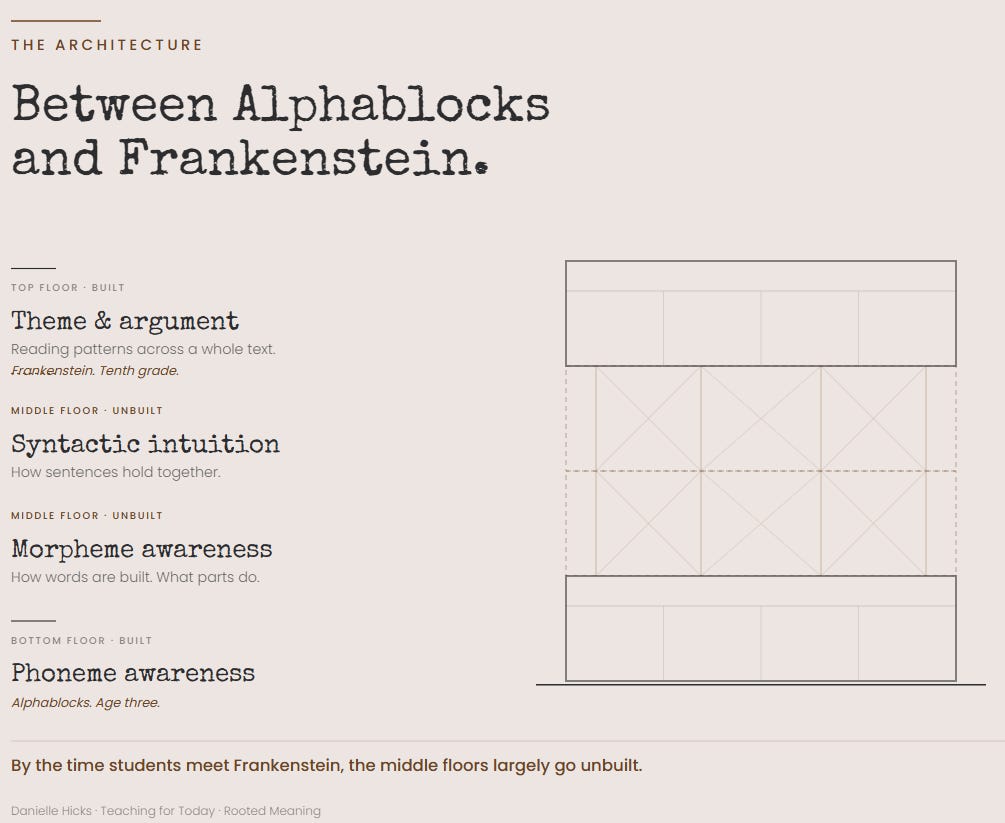
Alphablocks teaches letter-sound relationships. It’s working at the phoneme level — the smallest unit of sound in language. That’s one floor of the building.
Literary analysis, which is what I’m asking my tenth graders to do with Frankenstein, is working at the thematic and argumentative level, where they’re meeting meaning across a whole text and finding patterns across chapters. That’s the top floor.
The middle floors containing morpheme awareness, syntactic intuition, the logic of how words are built and how sentences hold together largely go unbuilt.
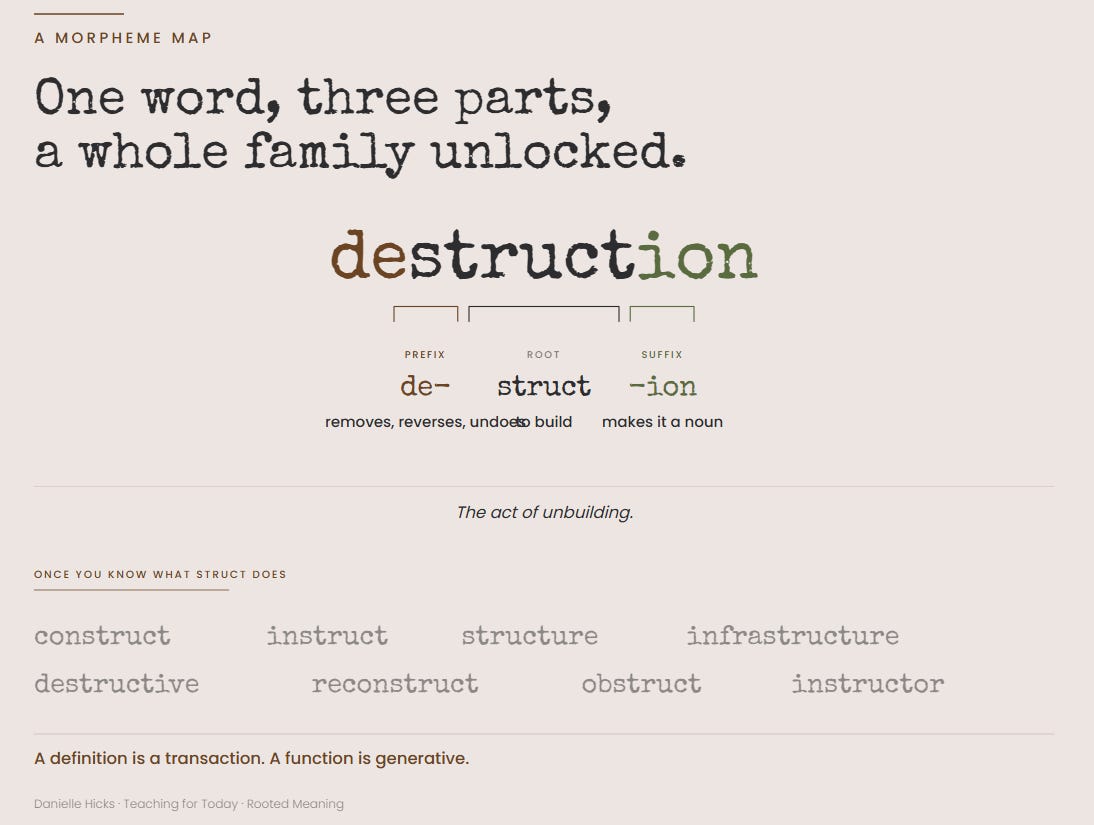
Students learn that un- means not and re- means again sometime around second grade, in a worksheet they forget that year. Then they arrive in my classroom fifteen years later and encounter destruction — one of Frankenstein‘s most repeated words — and they have no architecture for it. They don’t know that struct means to build, that destruction contains the word for building inside it, and that the same root is doing work in construct, instruct, structure, infrastructure. The word the novel keeps returning to — the thing Victor keeps causing — literally contains its opposite. That’s not just a vocabulary fact. That’s a thematic observation. But you can only see it if you know how the word is built.
Every unfamiliar word becomes a wall rather than a door.
The reason that gap is so durable, I think, is that most of the instruction aimed at closing it is built around the wrong question.
The question most vocabulary instruction asks is: do students know what this word means?
The question that would actually build the floor is: do students know what this word does?
Those are different kinds of knowledge, and they produce different kinds of instruction. When I teach benevolent as a definition — kind, generous, well-meaning — a student can recognize it on a quiz. They can write it in a sentence. They’ve acquired a fact about that word. But what they don’t have is any structural understanding of why the word means what it means, or what to do when they encounter benefactor, beneficial, benign, beneficence for the first time in a text next month.
The definition was a transaction. It didn’t build anything.
Multiply that by every vocabulary list, every unit, every grade level, for twelve years of school, and students accumulate word facts without ever acquiring word architecture. They know some words. They don’t know how words work.
The thing about morphemes is that they have jobs. De- removes, reverses, undoes. Struct builds. So destruction is the act of unbuilding, and once a student knows that, they don’t just know destruction. They have a handhold on a set of words they haven’t seen in deconstruct, destabilize, deflect, devolve, deactivate because they recognize the function of the part.
That’s generative knowledge. It grows. A definition doesn’t grow; it just sits there until a student forgets it, which they will, because isolated facts without architecture are the first things long-term memory releases.
I think the reason functional knowledge sticks when definitional knowledge doesn’t is that humans are wired to track what things do.
Not what things are. What they do.
A child who meets a new person doesn’t catalog their attributes. They watch their behavior. They notice what the person does when something goes wrong, how they respond when someone needs help, whether they’re the one who talks or the one who listens. Function is how we build mental models of people, and those mental models are extraordinarily durable.
This is why Alphablocks works. Each letter isn’t defined — it’s characterized. B bounces. H huffs. The letters have behaviors, not just sounds. A three-year-old watching B and H collide into a word isn’t memorizing phonics rules. They’re tracking what these characters do, and the pattern becomes intuitive because the intuition is built from behavior.
The same principle scales. A student who thinks of re- not as a prefix meaning “again” but as the part that shows up when something needs to be rebuilt, retried, restored — who has internalized re- as a function rather than a label will recognize it working in texts across their whole life.
This matters more than it might seem, because the gap doesn’t stay in vocabulary.
A student who doesn’t have morphological intuition also tends to struggle with sentence-level complexity, because complex sentences are built the same way complex words are: parts with jobs and relationships between parts. It’s a readable logic once you know how to look for it.
When a student reads Victor Frankenstein narrating his own story and can’t quite locate why it feels slippery they’re often not missing a literary analysis skill. They’re missing the syntactic awareness to notice that Victor’s sentences keep removing him from his own actions. I was led to… it seemed to happen… the creature came to exist. The grammar is the argument. But you have to be able to read the grammar to read the argument.
We teach students to look for theme and symbol and motif. We don’t spend as much time teaching them to read sentences the way architects read buildings — to notice the structure holding everything up.
I’m not arguing that we need to go back to diagramming sentences. (Or am I?) I know we have an uphill battle because not only are our students word-poor, they’re also grammar-weak.
What I’m arguing is that students need mental models for how language works at the word level and the sentence level before we can expect them to work fluently at the argument and theme level. The kind of intuition Alphablocks is building at three and four where a child internalizes the logic of how sounds work through characters and story and repetition, rather than the kind of instruction that produces correct answers on a worksheet and nothing transferable the following week.
The first time students encounter morphemes cannot be in high school. By then we’re already in remediation mode, trying to rebuild a foundation while simultaneously teaching them to analyze Victorian literature. That’s not impossible, but it’s teaching on hard mode.
Hendrick writes that to deny students systematic, cumulative instruction that builds morphological knowledge that treats vocabulary as knowledge rather than a checklist is to treat a knowledge deficit as a skills deficit.
That’s the diagnosis.
What I keep thinking about is the infrastructure that would make the diagnosis irreversible. Not another vocabulary strategy. Not a new way to introduce unfamiliar words. An actual architecture built early, built through story and character and pattern rather than worksheet and quiz, and designed so that what a child learns at four is still doing work at fourteen.
The middle floors of the building.
We’ve known for a while that phonics works. We know now that morphological awareness matters. Researchers like William Nagy and Richard Anderson have been making this case since the 1980s, arguing that morphological knowledge is one of the most powerful predictors of reading comprehension because it’s generative and one morpheme unlocks dozens of words.
What we don’t have yet is a coherent, compelling way to build that layer the way Alphablocks built the bottom layer. So that by the time students meet Frankenstein, the words aren’t walls.